
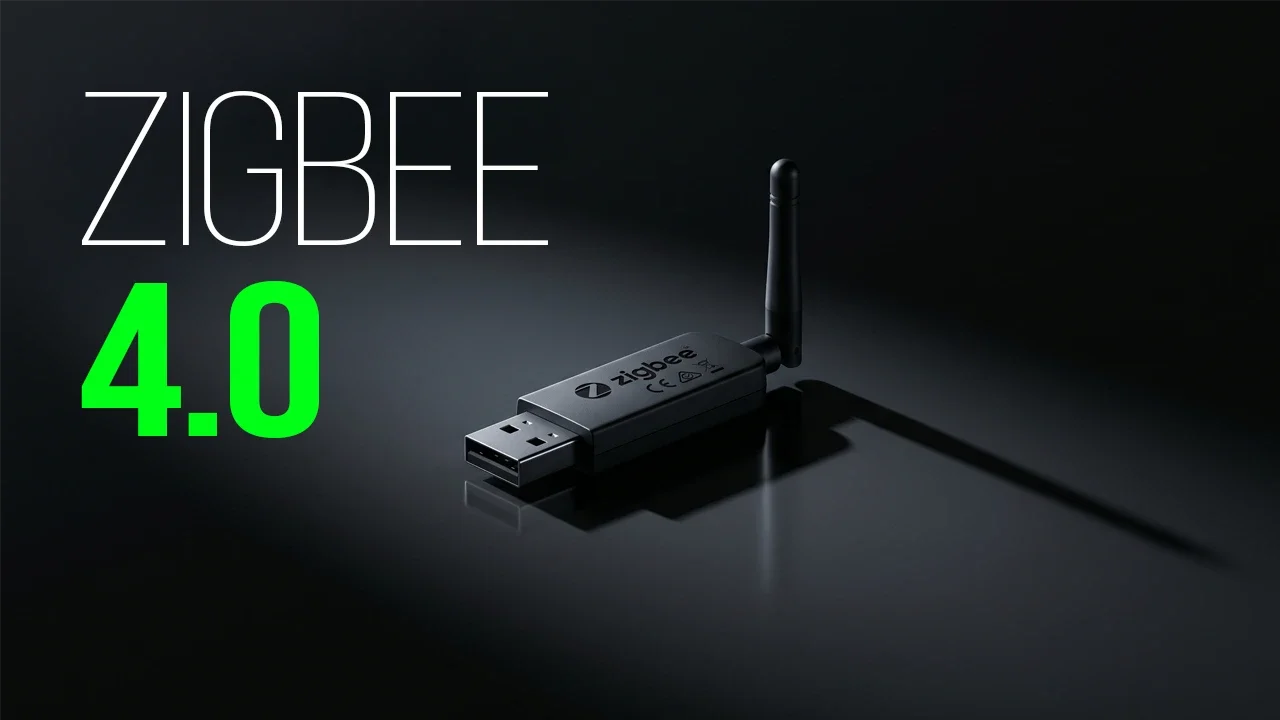
Zigbee wasn't dead, and it just proved it
For the past two years, a recurring narrative in the home automation community was: Zigbee is doomed. Matter would unify everything, Thread would make the old 2.4 GHz mesh obsolete, and our coordinators would end up in the closet next to first-generation Hue bulbs. Some of you may have even hesitated to continue investing in Zigbee for this reason.
Then, on November 18, 2025, the Connectivity Standards Alliance published a statement that caught everyone off guard: Zigbee 4.0 is official, accompanied by a new brand called Suzi to designate the long-range sub-GHz variant. This is the biggest evolution of the protocol since the release of Zigbee 3.0 in 2015, and it directly addresses all the criticisms that competitors have leveled against Zigbee for years.
Zigbee 4.0, what exactly is it?
The official announcement of November 18, 2025
Zigbee 4.0 is not a rumor or a working document: it is a finalized specification, published by the CSA from Davis, California. Certification for Zigbee 4.0 products has been already open for manufacturers since that date, and Zigbee 3.0 will remain valid for certification for at least 18 more months, roughly until mid-2027. Manufacturers therefore have a comfortable transition window.
Contrary to what might have been feared, the CSA did not choose the path of disruption. Zigbee 4.0 is explicitly designed to be fully backward compatible with Zigbee 3.0 and with Smart Energy profiles. Concretely, this means that the billion Zigbee sensors, bulbs, and plugs already installed worldwide will continue to function. No one will be left with a box of unusable hardware.
An ambitious specification
If you have ever deployed a large Zigbee network (beyond 50-60 devices), you know the pain points: adequate but aging security, sometimes capricious pairings, sensors dropping off, limited range due to the 2.4 GHz band where Wi-Fi, microwaves, and Bluetooth constantly compete. Zigbee 4.0 directly tackles all these problems at once.
The CSA defined four main objectives for this version: strengthening security for the coming decade, supporting campus- or industrial building-scale networks, simplifying mass deployment, and finally breaking the physical barrier of 2.4 GHz. It is this last point that changes the game the most for us, home users.
The major concrete new features
Suzi, the feature that steals the show
Let's start with the big one. Suzi (a contraction of Sub-GHz Zigbee) is the new brand for a variant of the protocol that operates on the 800 MHz bands in Europe and 900 MHz in North America. This is exactly the type of frequencies that Z-Wave has been using for years, with the known benefits: longer waves, better penetration of concrete walls, much greater outdoor range, and most importantly, no competition with your Wi-Fi or Bluetooth devices.
Be careful with a point often misunderstood: Suzi is optional in Zigbee 4.0. A device can perfectly be Zigbee 4.0 certified while remaining on 2.4 GHz and only benefiting from security and mesh improvements. Only products branded Suzi will utilize sub-GHz. Suzi certification has been opened by the CSA as announced, but no Suzi certified products are yet commercially available. The first ones are expected to arrive in 2026, probably not before summer for the earliest ones.
I will go into detail about Suzi in a dedicated section below, because it deserves a closer look.
Security overhauled
Security has been the historical criticism of Zigbee compared to Z-Wave S2 or new IP standards. Zigbee 4.0 introduces several mechanisms that clearly raise the bar:
- Dynamic Link Key (DLK): secure key negotiation during pairing, with the possibility of key rotation after an update. Gone is the theoretical risk of compromise by sniffing during device addition.
- Device Interview: the Trust Center can now examine a device's capabilities, endpoints, and clusters before allowing it access to the network. A sensor claiming to be something it's not will be unmasked.
- APS Frame Counter Synchronization: frame counters synchronize between endpoints, which blocks replay attacks and helps devices recover after a reset or power outage.
- Trust Center Swap Out: you can replace your coordinator without having to re-pair all your devices. This feature alone almost justifies the update for anyone who has ever migrated a network of 100+ sensors.
- Restricted Mode: only the Trust Center can modify the operational state of devices. This effectively blocks hijacking attempts.
In addition, there's Unique Link Key Monitoring, strict control over channel and PAN ID changes, and a new TLV (Tag-Length-Value) encoding format that modernizes how information flows in frames without breaking backward compatibility. Together, these provide a security foundation comparable to what is found in the latest protocols.
Zigbee Direct: pair without a hub, via Bluetooth
This is a feature that will resonate with users who have struggled to pair a sensor hidden behind furniture. Zigbee Direct allows a smartphone or tablet equipped with Bluetooth Low Energy to communicate directly with a compatible Zigbee device, to pair it, configure it, or even control it.
The principle is simple: your phone acts as a Zigbee Virtual Device (ZVD), it connects via BLE to the Zigbee device that exposes Zigbee Direct services (ZDD), and transmits all the necessary information for it to join your network. No more putting the coordinator in pairing mode, no more hazardous channel scanning, no more risk of joining the wrong network if you have multiple coordinators at home.
This is typically the kind of user experience that Matter has popularized and that Zigbee sorely lacked. However, be aware: this feature requires the device to integrate both a Zigbee radio and a BLE radio, which has a hardware cost. Not all future sensors will necessarily include it.
Batch Commissioning and mesh reliability
For those installing Zigbee on a large scale (commercial lighting, tertiary buildings), Batch Commissioning now allows multiple devices to be paired simultaneously instead of one by one. This saves an enormous amount of time on a job site.
Regarding network reliability, Zigbee 4.0 standardizes network-level retries (which existed but were inconsistently implemented by manufacturers), improves polling of sleepy devices (battery-powered sensors that sleep most of the time), and expands the use of APS acknowledgments. The routing protocol is also strengthened to eliminate routing loops and reduce unnecessary traffic.
If you've ever had a temperature sensor drop out once a week for no apparent reason, these changes should drastically reduce that type of behavior on a 4.0 network.
CSL: Even Longer Lasting Batteries
Coordinated Sample Listening (CSL) is probably the most discreet new feature, yet the one that will have the most concrete impact on your daily life. It allows battery-powered devices to sleep longer without losing synchronization with the network, and most importantly, it allows two sleepy devices to communicate directly with each other using low power.
Specifically, expect door, temperature, or motion sensors capable of lasting significantly longer on a CR2032 battery, potentially several additional years. For anyone who has ever juggled twenty batteries to replace at once, this is very concrete news.
Suzi and Sub-GHz in Detail
Why Going Below the Gigahertz Mark Changes Everything
To understand why Suzi is such a big deal, you need to understand the physics of radio waves. 2.4 GHz is a crowded highway: Wi-Fi, Bluetooth, microwave ovens, surveillance cameras, some baby monitors—everyone is clashing on this part of the spectrum. The waves there are relatively short, which limits penetration through concrete walls, slabs, and metal cages.
Sub-GHz bands, on the other hand, are much more peaceful and, most importantly, benefit from longer waves that penetrate obstacles better. This is exactly why Z-Wave has always had this reputation of "it works where Zigbee struggles." With Suzi, Zigbee suddenly catches up on this historical disadvantage.
Use Cases Where Suzi Will Shine
I'm talking about real-world range of several hundred meters outdoors and much better coverage in dense homes, old buildings with thick load-bearing walls, or difficult configurations (garden annex, basement, detached garage).
- Large or old houses: no more need to multiply repeaters to reach the back of the garden or the upper floor behind stone walls.
- Outdoor and exterior: soil moisture sensors, gate motion detectors, garden lighting control, weather stations.
- Commercial and industrial buildings: the CSA clearly targets this market, with mesh networks of several hundred devices on extended sites.
- Outbuildings and agricultural dependencies: greenhouses, connected chicken coops, equipped garden sheds.
Suzi vs. Z-Wave Long Range
The comparison is inevitable. Z-Wave Long Range (ZWLR) has been around for a few years and offers advertised ranges of up to 1.5 km in a straight line, with a star topology and up to 4,000 devices per network. Suzi, however, remains true to Zigbee's mesh philosophy and will focus more on density multiplied by sub-GHz range.
For very extensive projects with a few critical devices (alarms, power outage sensors, metering), ZWLR will retain an advantage in pure range. For dense residential or commercial networks where you need many interconnected devices with natural redundancy, Suzi will make perfect sense. With the Zigbee ecosystem being infinitely larger than Z-Wave's, the competition promises to be tough for the latter.
For those who have already invested in Z-Wave Long Range, I wouldn't say it was a bad choice: the hardware is mature, proven, and available today. But for new projects starting from late 2026, Suzi clearly deserves consideration.
Should You Change Your Current Hardware?
This is THE question I've been asked repeatedly since the announcement. I'll address it by use case, because the answer really depends on what you have today and what you want to do.
Your Current Zigbee 3.0 Devices: No Changes Needed
Let's start with the good news. Your Aqara sensors, Philips Hue bulbs, SONOFF plugs, Tuya detectors: they will all continue to work, without updates, without tinkering, without loss of functionality. Zigbee 4.0's backward compatibility is total on 2.4 GHz. A 4.0 coordinator will be able to talk to your 3.0 devices exactly as before.
You will not benefit from the new security features (DLK, Device Interview) on these devices, as they require 4.0 firmware on the device side, but you will maintain the current level of security without degradation.
Your 2.4 GHz Coordinator: Software Infrastructure is There, Firmware is Coming
Since the November 2025 announcement, things have moved quickly on the software side. Silicon Labs released Simplicity SDK 2025.12.0 integrating Zigbee 4.0 support in January 2026, followed by two minor revisions in February. On March 25, 2026, Silicon Labs then released EmberZNet 9.0 Revision 1, the official stack qualified as "Zigbee 4.0 certification-ready with BDB 3.1 and R23" in Production quality. This is the software brick that manufacturers will use to build their 4.0 compatible firmwares.
Modern coordinators based on Silicon Labs EFR32MG21, EFR32MG24, and EFR32MG26 chips can therefore technically receive Zigbee 4.0 on 2.4 GHz via firmware update. Affected models include:
- The SONOFF ZBDongle-E (EFR32MG21) and the SONOFF Dongle Plus MG24 (EFR32MG24).
- The Home Assistant Connect ZBT-2 (EFR32MG24), sold by Nabu Casa.
- The SMLight SLZB-06 range (SLZB-06M with EFR32MG21, SLZB-06Mg26 with EFR32MG26) as well as the multi-radio SLZB-MR which also embed EFR32 chips alongside TI chips.
- The TubesZB MGM24 PoE coordinators based on EFR32MG24.
A word of caution, however: as of April 2026, when I am writing these lines, none of these manufacturers have yet released official firmware based on EmberZNet 9.0. The Silicon Labs release is less than a month old; we need to give ITead, SMLight, and Nabu Casa time to compile, test, and publish. Reasonably expect the first community builds by summer 2026, and official firmware to follow shortly thereafter.
A second significant hurdle: EmberZNet 9.0 upgrades to EZSP v18, whereas Zigbee2MQTT and ZHA currently support EZSP v14 (EmberZNet 8.0) at most. Before you can actually use Zigbee 4.0 in your Home Assistant, an update will be needed on the zigbee-herdsman, Zigbee2MQTT, and bellows/zigpy (for ZHA) side. Discussions are already open on the relevant GitHub repositories, but no dates have been announced. My personal bet: experimental support during summer 2026, stable release more likely by the end of 2026.
In summary: the Zigbee 4.0 software infrastructure exists and works, but the distribution chain to your Home Assistant coordinator still has several links to complete.
To enjoy Suzi: new hardware required
This is where perfect transparency is needed. Suzi requires sub-GHz hardware radio that Silicon Labs EFR32MG21, MG24, and MG26 chips do not include. These are all 2.4 GHz radios only. No firmware will make your ZBT-2 or SLZB-06Mg26 transmit at 868 MHz: the corresponding radio does not physically exist in the silicon.
The same applies to most Texas Instruments chips used in current consumer coordinators: the CC2652P, CC2652R, and CC2674P10 (found in SLZB-MR, SONOFF ZBDongle-P, ZigStar UZG-01) are also 2.4 GHz only.
Chips that natively support 800/900 MHz sub-GHz bands are to be found in the Texas Instruments CC13xx family: CC1352R, CC1352P, CC1352P7, CC1354R, and CC1354P. These chips are multi-band and can operate at 2.4 GHz and sub-GHz simultaneously. Today, they equip a few niche or DIY coordinators (older TubesZB, ZigStar v4), but no widely distributed consumer products as of this writing.
Another point not to be overlooked: having sub-GHz hardware is not enough. You also need Zigbee firmware implementing the Suzi specification. Suzi certification by the CSA opened in Q1 2026 as announced, but neither Texas Instruments nor Silicon Labs have yet released a ready-to-use Suzi stack for their chips. Concretely, no consumer coordinator is capable of Suzi today in April 2026, even if its hardware theoretically allowed it.
My purchase advice in April 2026
Here is my recommendation based solely on what actually exists and works today:
If you already have a modern coordinator based on EFR32MG21, MG24, or MG26 (SLZB-06M, SLZB-06Mg26, ZBT-2, Dongle-E, Dongle Plus MG24), do not change anything now. You are well-positioned to receive Zigbee 4.0 at 2.4 GHz via firmware updates that will arrive during 2026. You will never have Suzi on this hardware, but there are no Suzi devices to buy today anyway.
If you are starting from scratch and need to buy a coordinator now, prioritize a recent model based on EFR32MG24 or EFR32MG26. These chips have enough flash memory and RAM to comfortably handle the additional features of Zigbee 4.0, whereas older EFR32MG21s might be more constrained in the long term. The SLZB-06Mg26 and Home Assistant Connect ZBT-2 are my top choices.
If Suzi is a decisive criterion for you, accept the obvious: no consumer coordinator is commercially Suzi-ready today. You will have to wait for TI or Silicon Labs to release a Suzi stack and for manufacturers to design new products around it. Keep an eye on announcements from SMLight, Nabu Casa, and SONOFF in the coming months, but do not pre-order anything blindly.
Quick summary of the main coordinators on the market and their ability to receive Zigbee 4.0 via firmware update:
| Model | Chip | Ready for Zigbee 4.0 |
|---|---|---|
| Home Assistant Connect ZBT-2 | EFR32MG24 (Silicon Labs) | ✓ Yes, via firmware 9.0 |
| SONOFF Dongle Plus MG24 | EFR32MG24 (Silicon Labs) | ✓ Yes, via firmware 9.0 |
| SONOFF ZBDongle-E | EFR32MG21 (Silicon Labs) | ✓ Yes, via firmware 9.0 |
| SMLight SLZB-06Mg26 | EFR32MG26 (Silicon Labs) | ✓ Yes, via firmware 9.0 |
| SMLight SLZB-06M | EFR32MG21 (Silicon Labs) | ✓ Yes, via firmware 9.0 |
| TubesZB MGM24 PoE | EFR32MG24 (Silicon Labs) | ✓ Yes, via firmware 9.0 |
| SONOFF ZBDongle-P | CC2652P (Texas Instruments) | ⏳ Pending (Z-Stack TI) |
| ZigStar UZG-01 | CC2652P2 (Texas Instruments) | ⏳ Pending (Z-Stack TI) |
| SMLight SLZB-MR3 / MR4 | CC2674P10 + EFR32MG24/MG26 | ◐ Partial (EFR32 radio OK) |
| Older CC2531 dongles | CC2531 (Texas Instruments) | ✗ No, chip too old |
⚠️ Important: no coordinator in this list will be able to do Suzi (sub-GHz). Suzi requires 800/900 MHz hardware radio, which is absent from all these chips.
Security considerations not to be overlooked
An important point before concluding on the security promises of Zigbee 4.0. New features like DLK, Restricted Mode, or APS Frame Counter Synchronization only protect your network if all actors in the chain implement them: coordinator, routers, and end devices. As long as your fleet is mostly composed of Zigbee 3.0 devices, you will benefit from the 3.0 security foundation for these devices, not the 4.0 one.
Another point: the adoption of Trust Center Swap Out will depend on software support in your stack. ZHA and Zigbee2MQTT will need to integrate the functionality for you to actually replace your coordinator without re-pairing. Do not assume immediate availability of this feature just because the spec allows it.
What is certain and what remains unclear
Officially confirmed points
The Zigbee 4.0 specification is published, certification has been open since November 18, 2025, Silicon Labs released EmberZNet 9.0 on March 25, 2026 in Production quality, and Suzi certification is also open. Zigbee 3.0 will remain certifiable for at least 18 months to ensure a smooth transition. All of this comes directly from the CSA and its major technical partners.
Remaining unknowns
Several questions remain unanswered to date:
- Manufacturer timeline: Aqara, Tuya, IKEA, Philips Hue and others have not yet communicated precise dates for their first 4.0 products. We can reasonably expect certified hardware in 2026.
- The exact status of Zigbee Direct: some analysts present it as mandatory in 4.0, others as optional. The official spec suggests it is a strongly encouraged central framework, but not strictly mandatory for all device types.
- Home Assistant integration: ZHA and Zigbee2MQTT have not yet published an official roadmap for 4.0. Discussions on zigpy and Koenkk have begun, but full support will take time.
- Real-world performance of Suzi in domestic conditions: announced ranges are theoretical. We will have to wait for the first real-world tests to see what it really performs like through two load-bearing walls and a concrete slab.
Conclusion: an unexpected breath of fresh air that positions Zigbee for the decade
My conviction is clear after poring over the spec and the positions of major players: Zigbee 4.0 is exactly the update the protocol needed. Full backward compatibility with existing devices, upgraded security, longer-lasting batteries, and sub-GHz to finally break the range glass ceiling. The CSA played it smart by not proposing a separate Zigbee but an evolution that protects the investment of the billion devices already deployed.
For you, concretely, here are my firm recommendations:
- Do you have a well-functioning Zigbee network today? Don't touch anything. You will gradually switch to 4.0 via firmware updates in 2026 without having to redo anything.
- Are you planning to buy a coordinator in the coming weeks? Get a recent model based on EFR32MG24 or MG26. You will be fully compatible with Zigbee 4.0 in 2.4 GHz as soon as the firmwares are released, without Suzi. No consumer Suzi-ready coordinator exists today anyway.
- Are you already dreaming of Suzi for your garden or annex? Patience. The first certified products won't arrive before summer 2026, and consumer sub-GHz coordinators a little later. There's no point in pre-ordering blindly.
- Were you hesitant to switch everything to Matter/Thread? Zigbee 4.0 gives you a serious reason not to burn your bridges. The two worlds will coexist for several more years, and Zigbee has clearly regained its long-term legitimacy.
What personally excites me the most is that Zigbee 4.0 isn't trying to replace Matter or fight against Thread: it asserts itself as the most mature, proven, and device-rich network layer on the market, with well-identified use cases where it surpasses the competition.