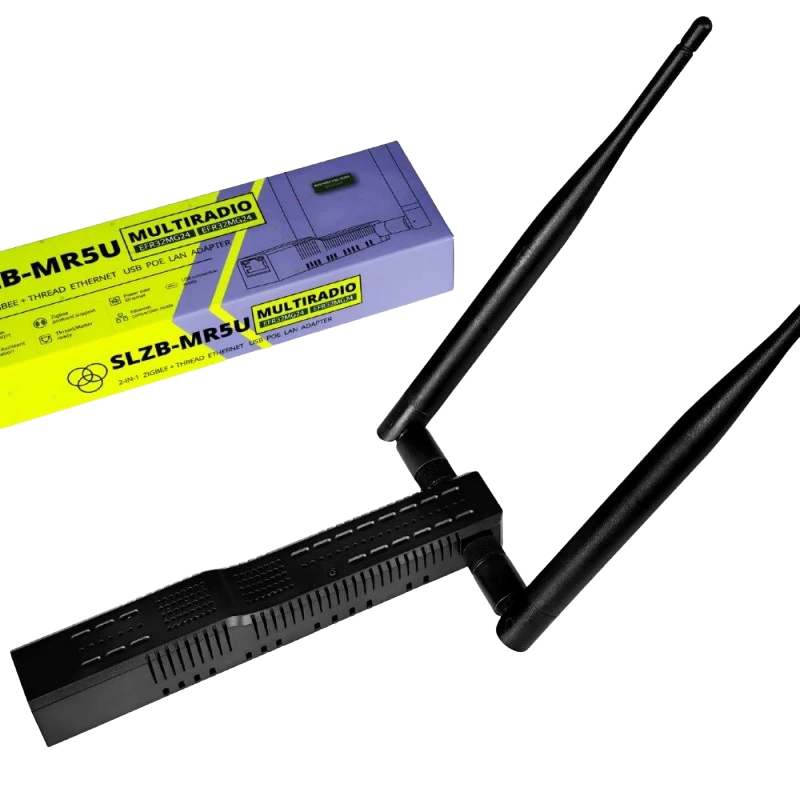
SMLight SLZB-MR5U - Zigbee & Thread Ethernet PoE Coordinator, Dual EFR32MG24, USB Passthrough, Home Assistant
The SLZB-MR5U is a multi-radio Ethernet PoE coordinator equipped with two EFR32MG24 chips to simultaneously manage Zigbee 3.0 and Thread. Compatible with Home Assistant, Zigbee2MQTT, and ZHA, it combines wired connectivity, USB passthrough, and external 5 dBi antennas.

Howmation's review
The SLZB-MR5U is clearly one of the most accomplished coordinators on the market to date. The combination of two identical Silicon Labs EFR32MG24 chips is a solid choice: it allows running a Zigbee 3.0 network and a Thread network in parallel, on two dedicated radios, without compromising performance. The addition of an ESP32-S3 chip to drive the web interface, Wi-Fi, and Bluetooth makes it a very clean Swiss Army knife for a serious home automation infrastructure.
Regarding Home Assistant, the integration is frankly exemplary. The dongle comes pre-flashed with SLZB-OS, auto-discovery works, and it can be used with both ZHA and Zigbee2MQTT. OTA updates go through the web interface, you have access to a local API, MQTT, and even WireGuard or a native OTBR for Matter. The big added value compared to an SLZB-06M, for example, is the USB Passthrough mode: you plug in a Z-Wave stick, a third-party dongle, or any UART adapter (CH340, CP210x, PL2303), and you access it from Home Assistant via TCP/IP. For centralizing all radios in a single enclosure placed in the middle of the house, it's formidable.
There are still a couple of things to keep in mind. First, you cannot power the SLZB-MR5U via both PoE and USB-C simultaneously; this is a serious hardware constraint as you risk damaging the board. Second, if you want to activate BLE Proxy mode to extend Bluetooth throughout the house, you need to flash ESPHome instead of SLZB-OS, which causes the dongle to lose its Zigbee and Thread functions. Finally, the SMLight range has become very dense (MR1U, MR3U, MR4U, MR5U, Ultima, SMHUB...), and for beginners, finding your way requires some research. Compared to the SLZB-MR4U, which mixes a Silicon Labs chip and a Texas Instruments chip, the MR5U plays the card of homogeneity, which makes it more consistent but not necessarily more performant in practice.
Ultimately, the rating is 4.5/5. It is currently one of the best choices for anyone looking to set up a stable, wired, entirely local Zigbee + Thread infrastructure managed from Home Assistant. The small missing point for a 5/5 is the exclusive PoE/USB-C power constraint and the dependence on SMLight firmware for BLE Proxy mode. For everything else, it's hard to do better in this price range.
Technical specifications
Radio chips: 2× Silicon Labs EFR32MG24 (Zigbee + Thread, simultaneous)
Main processor: ESP32-S3 dual-core @ 240 MHz
Ethernet SoC: WIZNet with isolated PoE transformer
Supported protocols: Zigbee 3.0, Thread, Matter-over-Thread, Wi-Fi, Bluetooth
Operating modes: Zigbee coordinator or router, Thread Border Router (OTBR), USB passthrough
Connectivity: RJ45 Ethernet, Wi-Fi, USB-C
Power supply: PoE 802.3af OR USB-C (never both simultaneously, risk of hardware damage)
Antennas: 2× external 5 dBi 3D adjustable antennas
Integrated amplifier: +20 dB
Home Assistant compatibility: Native via ZHA and Zigbee2MQTT, auto-discovery
USB Passthrough: UART via TCP/IP, compatible with CH340/CH341, CP210x, PL2303, CH9102 (confidence: high)
Firmware: SLZB-OS (web interface, local API, MQTT, OTA, WireGuard, DDNS), ESPHome optional for BLE Proxy
User interface: 6 status LEDs + physical button
Dimensions and weight: Not confirmed by consulted sources (confidence: low)
Design: Designed and manufactured in Ukraine