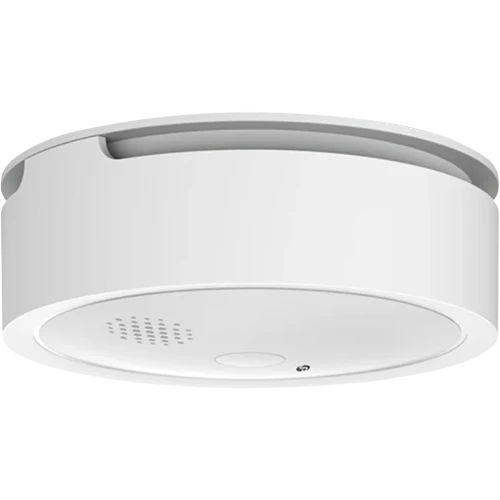
Shelly Plus Smoke - Connected Wi-Fi Smoke Detector, Photoelectric, EN14604 Certified, 85 dB Alarm, Local Home Assistant Integration
The Shelly Plus Smoke brings EN14604-certified photoelectric smoke detection directly into Home Assistant, 100% locally via native Shelly integration. CR123A battery, 85 dB alarm and local scenes, with no cloud or mandatory hub.

Howmation's review
The Shelly Plus Smoke is the smoke detector that ticks the regulatory box—it's EN14604 certified and therefore serves as a mandatory DAAF in France, while integrating cleanly into a home automation installation. Its real strength, as we know from Shelly: local first. No imposed cloud, no hub. The device connects via 2.4 GHz Wi-Fi, exposes its local API, and can trigger scenes or webhooks to other Shelly devices even without Internet connection. In case of smoke, it becomes possible to cut power to a room, switch lights to red to mark the exit, or send a notification—all in milliseconds over the local network.
On the Home Assistant side, it's solid. The device is supported by the native Shelly integration, built into the core of HA without going through HACS, in Local Push with auto-discovery. The sensor appears as a binary_sensor of smoke type, and battery status has its own entity. A fair downside though: since it's a battery-powered device, you often need to manually enable the Outbound WebSocket in the Shelly web interface for push updates to come through reliably. At its launch, the integration also suffered from a few bugs (device detected but without entities), which is fixed today, but it's worth flagging. For those who prefer it, the device also speaks MQTT, which allows quite a bit of configuration freedom.
Where I'm more reserved is on the principle itself: putting Wi-Fi on a battery-powered device for a security product raises questions. Wi-Fi consumes more than Zigbee, and the announced battery life varies all over the place depending on retailers—1 to 10 years on different datasheets, with field reports sometimes suggesting a battery already quite depleted on arrival. Fortunately, the local sound alarm of 85 dB remains autonomous and works even if Wi-Fi drops: the vital function is never compromised, it's the connected layer that depends on the CR123A battery, a format somewhat less common than AA. Adding sometimes painful pairing in the Shelly app and the lack of carbon monoxide detection, you get the full picture.
For someone already equipped with Shelly devices, it remains the logical and consistent choice: you stay in a controlled ecosystem, local-first, with a finely tuned HA integration. On the other hand, for a purely Home Assistant setup with a Zigbee coordinator already in place, a detector like the Frient Intelligent Smoke Alarm or a Heiman (via ZHA or Zigbee2MQTT) will often be more elegant: no Wi-Fi to manage on battery, and sometimes a long-lasting sealed battery. Against the Netatmo Smart Smoke Alarm, more mainstream but far more cloud-dependent, the Shelly clearly wins on local-first. My rating of 3.5/5 sums up the situation well: a good detector, honest and local-first, but with design compromises that prevent it from reaching excellence on a product where reliability must be flawless.
Technical specifications
Sensor type: Photoelectric, optimized for smoldering fires with slow combustion
Certification: EN14604, compliant with DAAF requirement in France
Connectivity: 2.4 GHz Wi-Fi (802.11 b/g/n) and Bluetooth 4.2 (used for pairing)
Home automation protocols: Local RPC API (WebSocket), MQTT, REST API, webhooks
Home Assistant integration: Native Shelly integration (core of HA), Local Push, auto-discovery
Voice assistants and platforms: Alexa, Google Home, SmartThings, Homey
Sound alarm: greater than 85 dB, with red LED light signal
Local operation: scenes and device-to-device actions without cloud or hub required
Webhooks: up to 10 configurable webhooks, 2 URLs each
Power supply: 1x replaceable CR123A battery, not included depending on retailer
Announced battery life: several years according to manufacturer, but inconsistent values across sources (1 to 10 years) and variable field reports (trust level: medium)
Dimensions: 86 x 86 x 31 mm
Weight: approximately 95 g
RF power and frequency: less than 20 dBm, 2401 to 2495 MHz
Operating humidity: 30 to 95%